28 YEARS LATER - MEMENTO MORI
Forgive me if I begin in medias res, with a feverish image that has haunted me since I left the cinema: a rag-clad survivor stands before a pyre of digital tablets and smart-watches, chanting as each gadget melts into primordial sludge. This is the implosion of Silicon Valley’s promise, and Boyle’s 28 Years Later thrusts us straight into it. The film is not merely another zombie spectacle; it is a Möbius strip of time, a hallucination in which the Middle Ages and a nightmarish tomorrow become indistinguishable. The Rage virus, supposedly “new,” actually functions as a historical boomerang: we are catapulted backward into a past that perhaps never existed, and yet—in its rawness, its un-medicated brutality—feels more real than our hyper-connected present.
The knight, the witch-doctor, and the Apple Watch
Capitalism loves to sell us the fantasy of linear progress: every iPhone launch, every IPO reinforces the doctrine that history moves upward, toward greater mastery and comfort. But step into 28 Years Later and that doctrine collapses. Boyle stages Britain as a neo-feudal archipelago—walled hamlets, torchlit patrols, barter economies—all while the ruins of Tesco superstores loom like cathedrals to a fallen faith. Technology has not liberated us; it has disintegrated, leaving behind only the debris of what Mark Fisher once called “capitalist realism,” that pervasive sense that there is no alternative. Suddenly, alternatives proliferate—yet they are archaic, blood-soaked, terrifying.
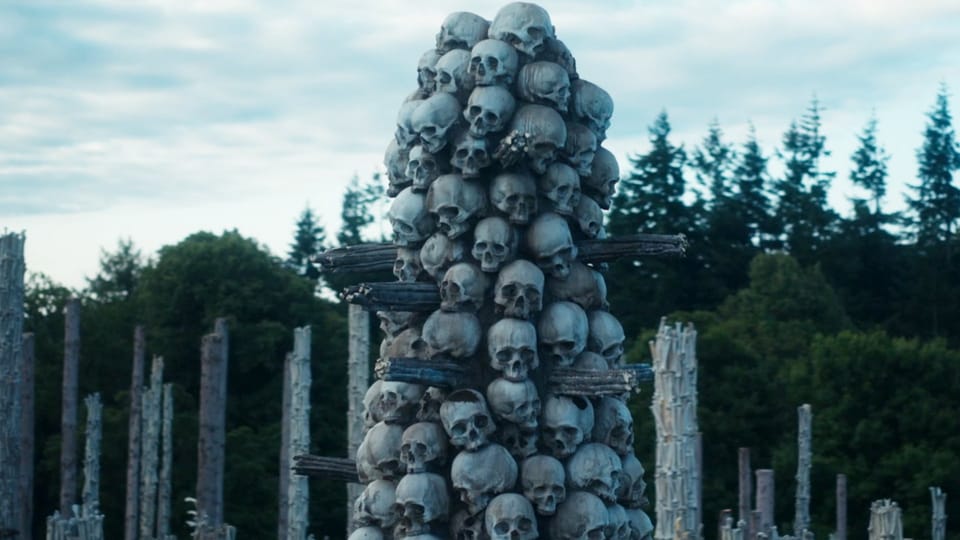
Enter Dr. Kelson, the so-called madman who communes with the infected. In every zombie franchise there is a scientist, but Kelson is different: half epidemiologist, half shaman, he bandages the wounded while mumbling prayers to the virus itself. He embodies what Michel Foucault described as le savoir des fous—a knowledge that official discourse must pathologize because it exposes the system’s internal rot. Kelson recognizes that to understand the Rage you must touch it, smell it, perhaps even desire it. Why? Because the infected are not “Others”; they are us, stripped of Apple-branded veneers, returned to the immediacy of the body. His clinic of skulls—a morbid archive of memories—echoes Bentham’s Panopticon inverted: no one surveils, no data are mined, only silence and bone remain.
Baudrillard’s nightmare comes true
Jean Baudrillard warned that late capitalism would end in the simulacrum: copies without originals, VR headsets in place of lived experience. 28 Years Later punctures that bubble with exquisite ferocity. Its London is not simulacrum but lacuna—a blank where meaning has been evacuated. Zombies sprint through Piccadilly Circus, yet the LED billboards still flicker advertisements nobody reads, like ghosts of the commodity form. It is, in short, the moment when the map no longer precedes the territory because the territory has devoured the map.
Notice the film’s colours: drained browns, rusty reds—tones we associate with medieval illustrations. This palette is not nostalgia; it is what Deleuze and Guattari might call a deterritorialization of chronology. The future collapses into the past, producing what Walter Benjamin described in his Theses on History: a “tiger’s leap into the realm of the past” that reveals the present’s hidden catastrophe. The Rage virus is merely the catalyst; the real infection is our dawning awareness that progress was always a fragile ideological side-effect of cheap energy and colonial plunder.
Our secret longing for ruin
Why does an audience flock—voluntarily!—to watch civilization annihilated? Here we must confront an obscene truth. Deep within the capitalist subject there smolders a primitive nihilistic wish: “Let it all burn, so we can finally feel something real.” In the film, survivors admit they sleep better when they hear zombies snarling outside the walls; the constant threat anchors them in their bodies, erasing the anxious self-monitoring demanded by LinkedIn profiles and wellness apps. The pandemic of the 2020s gave us a diluted taste of this suspension, but 28 Years Later pushes it to the extreme: no Zoom calls, no supply chains—only visceral immediacy.
This, I propose, is the fantasy of the anarcho-primitivists: that only through systemic collapse can we reclaim authentic community. Yet Boyle never slides into romanticism. The clans that form, the barter markets, even the tenderness between Isla and her son Spike—none of it disguises the brutality. The film says: Yes, you may regain communal bonds, but you will also confront predators and starvation. In other words, the price of authenticity is terrifyingly high, and there is no warranty, no consumer court to which one can complain.
Capitalism as the real Matrix
We often cite The Matrix to illustrate how ideology blinds us, but 28 Years Later flips the metaphor. Here, the apocalypse is the “red pill.” Once the grid collapses, the populace awakens from a dream of limitless streaming content into a landscape of mud, fire, and screaming. Paradoxically, the very brutality that horrifies us also makes life—how shall I say—worth living. The infected, in their pure rage, are the negative image of the capitalist subject who must smile for customer-satisfaction surveys. They remind us that passion, even destructive passion, is more real than manicured affect.
Kelson grasps this. He refuses to exterminate the zombies wholesale. Instead, he watches, records, communes—like an ethnographer in Levi-Strauss’s Brazil. By listening to their guttural howls, he divines humanity’s own repressed howl, the primal scream that consumer culture has anesthetized. Understanding the zombies becomes, for him, the route back to understanding the human. And is this not what Jacques Rancière calls “the redistribution of the sensible”? The boundary between sense and nonsense, human and inhuman, is rearranged under crisis.
The op-ed as alarm clock
So what lessons can we draw while we still inhabit the pre-apocalypse? First, the comforts we cherish may already be undead, dragging their pixelated limbs across an over-leveraged landscape. Second, our gadgets will not save us; they will form a funeral pyre. Third—and most scandalous—there is a libidinal satisfaction in watching it crumble. 28 Years Later functions as a collective dreamwork, staging the regression we are ashamed to admit we crave.
But dreams can also be alarms. Boyle’s film offers no blueprint for utopia; instead, it thrusts a mirror before us, smeared with blood and ash, and asks: Do you see now? Do you see that the same brutality we fear is also what tethers us to the Real? The task is not to romanticize regression, nor to cling to a dying paradigm of app-mediated life. Our task is to invent new forms of solidarity that neither idealize medieval savagery nor slump into algorithmic stupor.
Perhaps, then, the true horror is not the sprinting infected, but the possibility that we will watch this film, nod sagely, and return to doom-scrolling. 28 Years Later offers a grotesque gift: a glimpse of life without the capitalist Matrix. What we do with that glimpse—whether we organize, resist, or sink back into the blue-lit swamp of feeds—is the question the film leaves hanging.
Member discussion